
'China any day would prefer to team up with India and dump Pakistan once the resolution of the border dispute becomes an accomplished fact.'

A glance back at some important events that occurred in 2018.
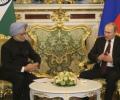
In a clear attempt to allay Russia's apprehensions, Prime Minister Manmohan Singh on Monday said it will remain an "indispensable" partner for India's defence needs even as he underlined that the bilateral ties should adapt to changing times to address challenges.

Global economy will have to grapple with few tough situations in 2015.

India is no longer shying away from playing a role on the regional and international stages and is willing to don a bigger role in regional politics. It is showing traits of a responsible stakeholder in the regional security dynamics, says Dr Rahul Mishra.

The two countries also decided to expand trade and commercial ties holding that there are opportunities to exploit untapped economic potential in the two countries.
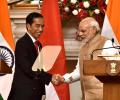
The two countries, among the very few fast growing large economies globally, also decided to boost bilateral trade and investment in areas of oil and gas, renewable energy, IT and pharmaceuticals, during talks between Prime Minister Narendra Modi and Indonesian President Joko Widodo.
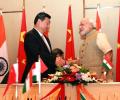
'China's actions at the NSG will certainly taint India-China bilateral relations and enhance suspicion of China's intentions. A fresh clear-eyed and objective evaluation of the India-China relationship is necessary, especially as India tries to correct adversely balanced bilateral economic ties and the two countries engage over the long-term,' says Jayadeva Ranade.

The Security Council as it is today is unable to bring peace and security in the world and so there is reason for countries like India to become members of the Council, Ambassador Asoke Kumar Mukerji tells Sheela Bhatt/Rediff.com.

'We are witnessing a spectacle of breathtakingly creative diplomacy at work, riveted on the firm foundations of the country's strategic autonomy,' says Ambassador M K Bhadrakumar.

India along with the G4 nations said it is "unfortunate" that momentum could not build up over the issue in the current session.

'The surge of Saudi nationalism is the last thing Washington wants,' says Ambassador M K Bhadrakumar.
.jpg)
Expressing concern over the investment and innovation environment in India, a top US trade official has said the recent set of economic reforms initiated by the country were not enough to return to the path of robust growth.

Dinesh Patel, Utah's most high profile and influential Indian American, was conferred the Willem J Kolff Lifetime Achievement Award at BioUtah's 2013 Utah Life Science Award, the state's top science award ceremony.

In most cases, the payback on energy saving projects offered by GIBSS are between one and three years.

'Xi Jinping got a dose of Modi's medicine inside the tent where he was being hosted on the banks of the Sabarmati river.' 'Modi reportedly told him, looking deep into his eyes: "This was not expected of your country. Can you tell me when the troops are withdrawing?".'

'Fearlessness, courtesy, humour, wide interests and wisdom, deep commitment to science and technology, passion for the environment, objectivity and the ability to see many things through not only a national but also an international prism.'

The Sheikh Hasina-Narendra Modi summit put India-Bangladesh ties on a firmer pitch. Brigadier S K Chatterji (retd) takes stock.

'We should not have waited for the political crisis in Nepal to erupt before being galvanised into action,' says Shyam Saran. 'We should have seen what was coming and not accepted assurances from the leaders of the political parties at their face value.'

'What gives hope is that Modi's own leadership is vitally linked to his capacity to deliver on the economic front. Indeed, if he succeeds, India's foreign policies will have changed beyond recognition,' feels Ambassador M K Bhadrakumar.

'To consider BRICS anything more than a temporary club with some common interests would be folly. The goal should be to induce others (Japan, ASEAN, South Africa) to align with us -- a non-threatening, democratic nation, rather than with malevolent China or waning America. For us to consider aligning with either China or the US would be absurd. India is just too big to be a sidekick,' says Rajeev Srinivasan.

'The intrusion in Chumar, during and beyond the Chinese president's visit, is unprecedented and has qualitatively changed the tone of the India-China relationship,' says Jayadeva Ranade, a member of the National Security Advisory Board.

'The Modi government's pusillanimity vis-a-vis Pakistan makes almost certain that India will, in the coming weeks and months, be confronted with cross border terrorist actions of increasing intensity,' warns Satish Chandra, former deputy national security adviser.

The Indian government should resist the temptation to make a grand gesture of friendship towards Nawaz Sharif, says Shyam Saran

'The Senators were playing safe, not angering either the pro-India lobby or the pro-Pakistan lobby, but perhaps more importantly, the military-industrial complex -- the most powerful lobby of all -- which the majority of Senators are beholden to in terms of largesse to their campaign coffers.'

'Modi and Obama both had agendas that went beyond the nuclear deal. The threat from the chilly Himalayas had to be tackled in the warm waters of the Indian Ocean.'

Narendra Modi's promise to allow states a bigger say in strategising and building foreign policy is unexceptionable, says TP Sreenivasan.

Boosted by handsome royalty from oil facilities at Barmer, the Rajasthan government has spent nearly Rs 30,000 crore on various social welfare schemes in the last four-and-a-half years. Chief Minister Ashok Gehlot tells Business Standard's Mayank Mishra that the state's better performance on various socio-economic indices is a result of that. The excerpts:

'The US wants Modi to succeed because we want India to succeed. For our part, when India thinks of its partners in the world, we want it to think of the US first. That means positioning our country as the preferred provider of the key inputs that can help to propel India's rise.' 'The meeting between Modi and Obama is, and must be, an opportunity for true strategic dialogue -- not a scripted exchange of talking points, but an open discussion of the big questions. What kind of world do we want to live in? What are our true priorities? And most importantly, why does this partnership still matter?'

Prime Minister Manmohan Singh on Friday disagreed with those in the Congress who were dismissive of the challenge posed by Narendra Modi but asserted that the party would approach the 2014 Lok Sabha polls with self-confidence, irrespective of the results of the just concluded elections in five states.

Prem Panicker, a keen follower of the game and one of cricket's finest writers, interacted with readers on the Rediff World Cup Chat.
